New Delhi | October 17, 2026 | Political News Desk
India’s “Vote Chori” controversy has intensified as Congress leader Rahul Gandhi and opposition parties challenge the Election Commission of India’s handling of electoral-roll revisions. The dispute has expanded from allegations of voter-list irregularities into a broader political confrontation over democratic accountability, institutional transparency and claims of foreign influence.
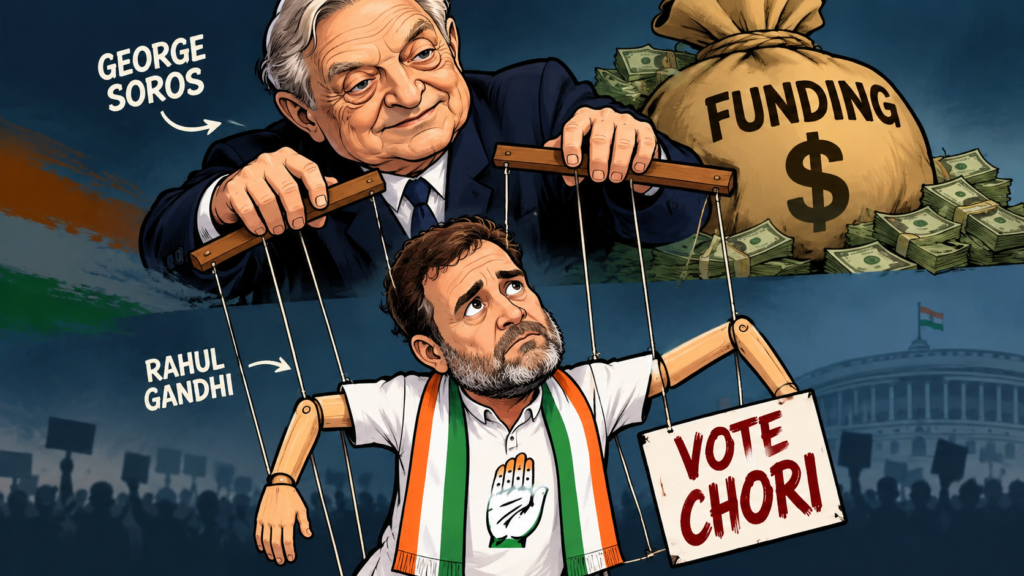
While Rahul Gandhi has repeatedly accused the BJP and election authorities of compromising electoral fairness, the Election Commission has maintained that its voter-roll revision exercise is intended to identify and remove ineligible entries. Meanwhile, public allegations linking billionaire George Soros to protests against India’s election authorities have added another dimension to the political debate. However, a direct financial or organisational connection between Soros and Gandhi’s Vote Chori campaign has not been established by the evidence cited here.
Rahul Gandhi Escalates the Vote Chori Campaign
Rahul Gandhi has made electoral transparency a central issue in his criticism of the BJP-led government. His allegations concern voter-list revisions, the removal of names, administrative procedures and the independence of election authorities.
The controversy intensified in September after an investigation by The Indian Express reported that Election Commissioners Sukhbir Singh Sandhu and Vivek Joshi had raised objections to several decisions within the Election Commission. Gandhi cited the reported disagreements while renewing his accusations against the BJP and the poll panel.

In October, opposition leaders took their challenge to the Supreme Court. A petition filed by opposition representatives raised concerns about the Election Commission’s decision-making, changes to voter-registration procedures and the administration of electoral databases. The petition seeks greater transparency and safeguards for eligible voters.
These are allegations and legal arguments, not a final judicial finding that an election was stolen. Their significance will depend on the evidence examined by the courts and the responses provided by the relevant authorities.
Voter Deletions Raise Questions About Electoral Transparency
The Special Intensive Revision, or SIR, has become the central issue in the controversy. The Election Commission describes electoral-roll revision as a process for identifying deceased voters, people who have moved, duplicate entries and other ineligible registrations.

Opposition parties argue that the scale and implementation of the exercise raise concerns about eligible citizens losing their right to vote.
In Maharashtra, Rahul Gandhi criticised the draft electoral rolls after the Election Commission reported that approximately 2.07 crore entries were marked for deletion during the draft-stage revision. The Commission cautioned that the figure should not be interpreted as the final number of voters removed. <Cite refs={[“turn944190search6”]}/>
This distinction is essential. A draft-stage deletion figure does not establish that every affected person was eligible to vote, nor does it prove deliberate manipulation. Equally, administrative explanations should not prevent independent examination of cases in which eligible voters may have been wrongly excluded.
The key questions are whether affected citizens received appropriate notice, whether they could challenge decisions, and whether errors were corrected before elections.
George Soros Allegations: What Is Actually Established?
George Soros has frequently featured in Indian political debates about international funding, civil society and foreign influence. His name has also appeared in recent public allegations concerning protests against India’s Chief Election Commissioner.

On October 16, 2026, The Times of India reported that American singer Mary Millben alleged Soros was funding protests targeting the Chief Election Commissioner. The report describes her claims; it does not, by itself, establish that the allegations are true. <Cite refs={[“turn944190news10”]}/>
More importantly, an allegation about protest funding is not proof that Soros directs Rahul Gandhi’s electoral campaign. Establishing such a connection would require reliable financial records, documented organisational links or findings from a credible investigation.
No such direct link is established by the sources cited in this report. It would therefore be inaccurate to describe the Vote Chori campaign as a Soros-funded operation without further evidence.
Opposition Moves the Dispute to the Courts
The opposition’s legal challenge represents an effort to move the dispute beyond political speeches and public demonstrations.
The petition reported by India Today raises questions about changes to Form 6, the statutory application used to register eligible voters, and the centralised administration of electoral data. It seeks greater transparency and safeguards against the wrongful exclusion of citizens. <Cite refs={[“turn944190search5”]}/>
These issues warrant examination because electoral rolls form the foundation of the voting process. At the same time, filing a petition does not establish that every allegation contained in it is correct. The legal process must assess the applicable law, the documentary record and the Election Commission’s explanation.
An independent audit of disputed records, transparent deletion data and an effective appeals process could help resolve factual questions while protecting eligible voters.
Political Battle or Evidence-Based Accountability?
The Vote Chori controversy illustrates how electoral administration can become a national political flashpoint. For the opposition, the priority is to establish whether voter-list procedures have disadvantaged eligible citizens. For the Election Commission, the challenge is to demonstrate that its processes comply with the law and operate fairly.
The separate debate about foreign influence requires the same standard of proof. Political criticism of Soros, ideological disagreements or the timing of demonstrations cannot independently establish a funding arrangement.
The most constructive path forward is to publish verifiable records, investigate specific complaints and allow independent legal scrutiny to determine whether rules were violated.
Conclusion
Rahul Gandhi’s Vote Chori campaign has placed electoral-roll transparency and the Election Commission’s accountability at the centre of India’s political debate. Reported disagreements within the Commission, opposition legal proceedings and disputes over voter deletions make the issue worthy of detailed scrutiny.
However, claims of deliberate electoral theft must be distinguished from documented administrative disputes, and allegations involving George Soros must be supported by evidence before being presented as fact.
The central question remains whether every eligible Indian citizen can register, remain on the electoral roll and exercise the right to vote without wrongful interference. That question deserves answers grounded in evidence rather than political speculation.