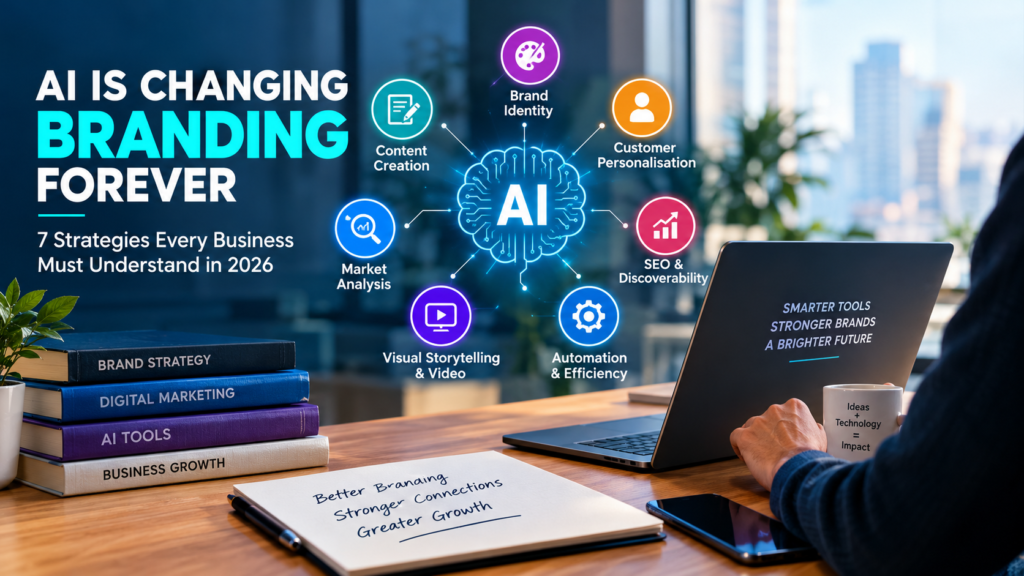
AI Is Changing Branding Forever: 7 Strategies Every Business Must Understand in 2026
Branding is no longer limited to creating a logo, choosing brand colours, and publishing advertisements. In 2026, businesses must build memorable identities, communicate consistently, understand customer behaviour, and deliver meaningful experiences across digital platforms.
Artificial intelligence (AI) is transforming how businesses approach these activities. From generating marketing ideas and analysing customer feedback to personalising campaigns and producing creative content, AI gives businesses new ways to compete in crowded markets.
The biggest opportunity is not simply using AI to produce more content. It is using AI strategically to communicate what makes a brand different.
Whether you run a startup, a local shop, an e-commerce company, or an established business, these seven AI branding strategies can help you strengthen your market presence.
1. Build a Consistent Brand Identity With AI
A strong brand identity helps customers recognise and remember your business. However, many small businesses struggle to maintain consistency across websites, social media profiles, advertisements, product packaging, and promotional materials.
AI-powered design and writing tools can help establish a consistent brand system.
Businesses can use AI to explore logo concepts, colour combinations, typography styles, visual themes, and brand messaging. They can also develop a brand voice that reflects their personality, whether professional, friendly, premium, playful, or innovative.
For example, a premium dry fruits brand could use AI to brainstorm elegant product descriptions, festive campaign concepts, packaging ideas, and social media captions that communicate quality and trust.
Marketing hack: Create a one-page brand guide containing your colours, fonts, logo rules, tone of voice, target audience, and key messages. Use it as a reference whenever you generate new content with AI.
Remember that AI-generated designs should be reviewed for originality, readability, trademark conflicts, and practical usability before publication.
2. Create More Marketing Content in Less Time
Consistent content helps brands remain visible, educate customers, and build relationships with their audiences. However, producing fresh content every day can be difficult for small teams.
AI can simplify content planning and production.
A single topic can become multiple marketing assets. For example, a blog about the benefits of buying directly from a brand can be converted into an Instagram carousel, a short video script, a LinkedIn post, an email newsletter, and a set of frequently asked questions.
AI writing assistants can help with outlines, headlines, captions, and content variations. Image and video tools can support creative production, while scheduling platforms can organise publication.
However, publishing large volumes of generic, repetitive content is unlikely to create a distinctive brand.
Marketing hack: Plan your content around three pillars: education, trust, and conversion. Share useful advice, demonstrate your product or expertise, and provide clear reasons for customers to take action.
Add original examples, genuine customer insights, and your own perspective to every important piece of content.
3. Personalise Customer Experiences Using AI
Customers increasingly expect businesses to understand their needs. Generic messages may be ignored, while relevant communication can make a brand more useful and memorable.
AI can help businesses analyse customer preferences, organise feedback, and create different messages for different audience segments.
An online store, for example, might communicate differently with first-time visitors, repeat customers, and shoppers interested in a particular product category. A service business could create separate campaigns for startups, local retailers, and established companies.
Personalisation can also improve product recommendations, customer support, email campaigns, and website experiences.
However, businesses should use customer data responsibly, obtain appropriate consent, and avoid collecting information they do not need.
Marketing hack: Start with simple customer segments. Group customers by their interests, purchase history, or stage in the buying journey. Send relevant, useful messages instead of sending the same promotion to everyone.
The objective is to make customers feel understood, not monitored.
4. Use AI to Understand Competitors and Market Trends
Successful branding requires more than knowing your own business. You must also understand the market, customer expectations, and how competitors position themselves.
AI can help organise publicly available information, summarise customer reviews, identify recurring complaints, and compare messaging across competing brands.
For example, a local restaurant might discover that customers frequently praise competitors for fast delivery but complain about inconsistent packaging. These observations could inspire a stronger brand promise centred on reliable service and thoughtful presentation.
AI can also help identify common questions in your industry and generate ideas for informative content.
Nevertheless, AI-generated research may contain inaccuracies or outdated information. Verify important findings using reliable sources and actual customer feedback.
Marketing hack: Analyse 20–30 publicly available customer reviews across your own business and relevant competitors. Identify recurring praise, complaints, unmet needs, and frequently asked questions. Use those insights to improve your messaging and customer experience.
Never copy a competitor’s identity. The goal is to discover opportunities to differentiate your brand.
5. Strengthen SEO and Discoverability With AI
A memorable brand needs to be discoverable when potential customers search online.
AI can assist with keyword research, content outlines, search intent analysis, FAQ development, internal-link planning, and the improvement of existing website pages.
For local businesses, this can include creating useful location-specific pages, answering common customer questions, and improving descriptions of products and services.
For example, a website development company could publish helpful articles about website costs, choosing a domain name, improving website speed, and selecting an e-commerce platform.
These resources can demonstrate expertise and attract visitors who are already looking for solutions.
AI should support quality rather than replace it. Search visibility depends on many factors, including relevance, usefulness, website quality, competition, and credibility. No AI tool can guarantee first-page rankings.
Marketing hack: Build one detailed article around a specific customer problem, then link it to relevant service pages and related articles. Include practical examples, original insights, and a clear next step for readers.
6. Make Short-Form Video and Visual Storytelling More Effective
Short-form videos provide opportunities for brands to demonstrate products, explain services, share behind-the-scenes moments, and communicate their values.
AI tools can help brainstorm video concepts, write scripts, generate subtitles, edit footage, and explore creative formats.
A simple video structure is:
- Hook: Present an interesting question or problem.
- Value: Share a useful tip, demonstration, or insight.
- Proof: Show a real example, product feature, or customer experience.
- Call to action: Encourage viewers to comment, visit the website, or explore the product.
For example, a clothing brand could demonstrate how to style one outfit in three ways, while a digital marketing agency could explain common mistakes businesses make when creating websites.
AI-generated visuals can support campaigns, but businesses should avoid misleading product representations or synthetic testimonials presented as genuine customer experiences.
Marketing hack: Test three different opening hooks for the same video topic. Compare watch time, completion rate, shares, saves, and meaningful enquiries to learn which approach connects best with your audience.
7. Combine AI Automation With a Human Brand Voice
AI automation can help businesses respond faster, organise leads, answer common questions, and manage routine marketing tasks.
Chatbots may handle basic enquiries, while automated email sequences can welcome subscribers, provide helpful resources, and follow up with interested customers.
These systems can improve efficiency, but automation should not make a business feel impersonal.
Customers still value honesty, empathy, accountability, and access to human assistance when a situation becomes complicated.
Marketing hack: Automate repetitive tasks, but keep humans involved in sensitive complaints, important sales conversations, brand decisions, and final content approval. Review automated responses regularly to ensure they remain accurate and aligned with your brand values.
Conclusion: AI Is a Tool, but Your Brand Is the Advantage
AI is changing branding by making research, creative production, personalisation, and marketing automation more accessible. Small businesses can now explore capabilities that previously required larger teams and budgets.
However, technology alone cannot create a meaningful brand. Customers remember businesses that solve real problems, deliver consistent experiences, communicate honestly, and offer something distinctive.
The strongest AI branding strategy for 2026 is to combine intelligent tools with human creativity, reliable information, and a clear understanding of your audience.
Start small: Document your brand identity, plan a month of useful content, analyse customer feedback, and test one AI-powered workflow. Measure the results and improve your approach over time.
The brands that stand out will not necessarily be those that use the most AI. They will be those that use it thoughtfully to become more relevant, recognisable, and valuable to their customers.