Startups

Brand Stories Business Openings City News Corporate News Entrepreneurship Local Business Startups Startups & MSMEs

Engineering Was the Dream. Business Became the Destination: The Suryansh Pandey Story

Digto Media Feature Story: Engineering Was the Dream. Business Became the Destination: The Suryansh Pandey Story

AURAIYA: During an interview, entrepreneur Suryansh Pandey spoke about the career journey that took him from his hometown of Auraiya to Ghaziabad and later to Kanpur, where he is pursuing an MBA at PSIT. The founder of Mewa Darbar explained how his original ambition of becoming a civil engineer eventually gave way to business education, digital marketing and entrepreneurship.

Recalling his early ambitions, Pandey explained that civil engineering was once the career he wanted to pursue. However, when that plan did not work out, he decided to take a different direction and enrolled in a Bachelor of Business Administration (BBA) programme at I.T.S. Mohan Nagar, Ghaziabad.

“My Career Took a Different Turn”

Speaking about his change in direction, Pandey reflected on how his early plans differed from the path he eventually chose.

“Initially, I wanted to become a civil engineer. However, things did not work out as I had planned, and I decided to pursue BBA in Ghaziabad. That decision introduced me to a completely different world of business, management and marketing,” he said, according to the interview account.

He explained that choosing a different academic path helped him discover interests he might not otherwise have explored. His time in Ghaziabad became an important phase in developing his understanding of business and identifying his professional interests.

How Ghaziabad Shaped His Skills

During the interview, Pandey also discussed the role his college environment played in his development. He recalled how industrial visits organised during his graduation helped him understand business operations beyond classroom lessons.

He also credited his digital marketing faculty and trainer, Aman Sir, at I.T.S. Mohan Nagar for helping shape his digital marketing skills.

“College gave me opportunities to learn beyond textbooks. Industrial visits helped me understand how businesses work in the real world, while learning digital marketing helped me see how businesses can reach customers and build their brands online,” he explained.

For Pandey, these experiences helped connect academic learning with practical applications. Digital marketing gradually became an area of interest that would later influence his entrepreneurial ambitions.

From Digital Marketing to Mewa Darbar

When discussing the idea behind Mewa Darbar, Pandey’s journey moved from education to business creation. His interest in digital marketing and branding provided a foundation for exploring opportunities in the dry fruits market.

Mewa Darbar aims to develop its presence through online channels while expanding its retail opportunities. The business operates in a competitive category where product presentation, customer trust, pricing and service can all influence purchasing decisions.

Reflecting on his entrepreneurial direction, Pandey described the importance of applying his learning to real-world business challenges.

“Learning a skill is one thing, but applying it to build something of your own is a different experience. With Mewa Darbar, I want to use what I have learned about marketing and business to develop a brand and reach more customers,” he said, as paraphrased for this article.

As the brand develops, its ability to maintain consistent product standards, build customer relationships and manage distribution will be important to its long-term progress.

From Graduation in Ghaziabad to an MBA in Kanpur

After completing his BBA, Pandey continued his education by pursuing an MBA at PSIT Kanpur. He is now combining management education with his entrepreneurial interests.

During the interview, he reflected on how his professional outlook had changed since his school years. What began as an ambition to enter engineering gradually evolved into an interest in management, digital marketing and building a consumer brand.

His educational journey connects three important places: Auraiya, where he studied at St. Francis Academy; Ghaziabad, where he completed his BBA and developed his digital marketing skills; and Kanpur, where he is pursuing his MBA.

“The Journey Is Still in Progress”

Asked about the road ahead, Pandey’s story points towards the challenges of turning a developing venture into a sustainable business. Expanding a consumer brand requires more than online promotion. It also demands effective operations, customer satisfaction, financial planning and dependable distribution.

Mewa Darbar’s future growth will depend on how effectively the business addresses these priorities while developing its online and retail presence.

Pandey’s journey offers a reminder that an early career setback does not necessarily determine a person’s future direction. His civil engineering ambition did not materialise, but pursuing BBA introduced him to a different set of opportunities.

From the classrooms of Ghaziabad to his MBA studies in Kanpur, he has continued to develop his business interests while working on Mewa Darbar.

For Suryansh Pandey, the story is no longer only about the career he once imagined. It is about the business he is working to build—and the challenge of turning that ambition into lasting success.
Brand Stories Business & Economy City News Consumer Corporate News Entrepreneurship Local Achievers Local Business PR & Communications Startups Startups & MSMEs Wellness

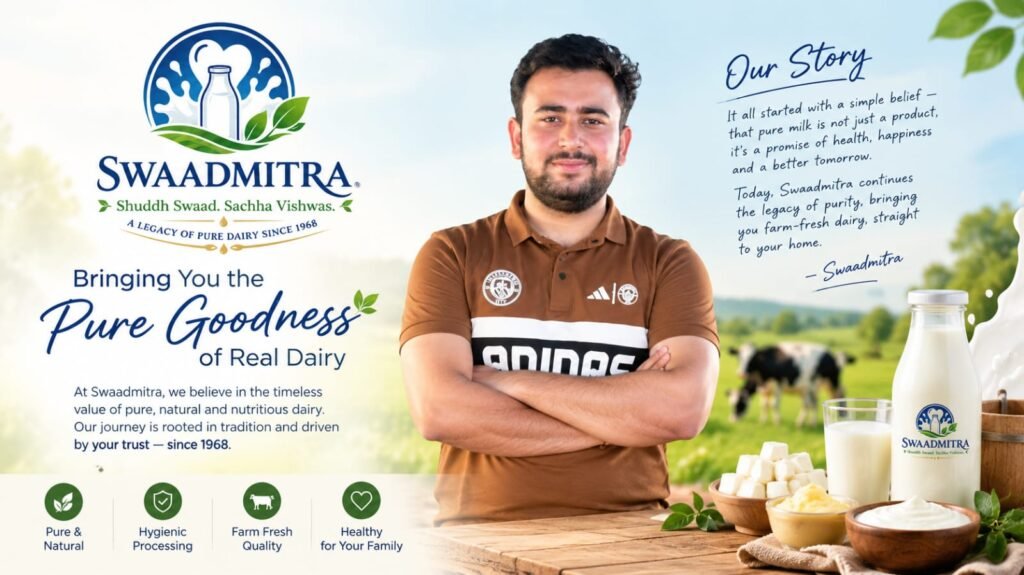
Swaadmitra: Palwal’s Emerging Dairy Startup Sells 1,000+ Boxes in a Month, Blending Legacy With a New-Age Vision

Swaadmitra: Palwal’s Emerging Dairy Startup Sells 1,000+ Boxes in a Month, Blending Legacy With a New-Age Vision

Palwal, Haryana: In a time when consumers are increasingly looking for freshness, quality and transparency in everyday food products, a young entrepreneur from Palwal is taking a traditional family dairy business into a new generation. Vansh Arora, founder of Swaadmitra, is building the brand around a simple idea—bringing the goodness of dairy to consumers while preserving the trust associated with a family legacy.

The startup has recently crossed an important early milestone, selling more than 1,000 boxes in a single month, reflecting growing consumer interest and the potential of a young brand operating in the competitive dairy segment.

What makes Swaadmitra particularly interesting is the story behind its founder. Vansh Arora is not entering the dairy business as an outsider looking for a new market. Instead, he is working to modernize and expand his family’s legacy dairy business, combining traditional experience with contemporary branding, packaging and customer-focused thinking.

From Family Legacy to Startup Vision

Swaadmitra’s story is closely connected with the family’s long association with dairy. The brand presents itself as carrying forward a dairy legacy dating back to 1968, with a focus on purity, natural products and consumer trust.

For Vansh, the objective is not simply to sell dairy products. It is about taking an established family business and building it into a recognizable modern brand.

This transition represents a familiar challenge for India’s family-run businesses. While generations may have built businesses through relationships and reputation, the next generation increasingly has access to digital marketing, e-commerce, modern packaging, social media and data-driven business decisions.

Vansh’s journey reflects that transition.

A Young Founder Balancing Education and Entrepreneurship

Vansh Arora completed his BBA from I.T.S Mohan Nagar, Ghaziabad, as part of the 2022–2025 batch. During his academic journey, he was exposed to business fundamentals, marketing, management and entrepreneurship.

Rather than waiting until the completion of his education to enter the business world, Vansh began focusing on the growth of his family enterprise.

He is currently pursuing an MBA from Amity University, while simultaneously working on expanding Swaadmitra.

Managing higher education alongside an operating business can be demanding. However, for Vansh, the combination offers an opportunity to apply classroom knowledge directly to a real business environment.

Marketing concepts, customer behaviour, branding, operations and business strategy are no longer simply academic subjects. They become practical challenges that need to be addressed while building Swaadmitra.

1,000+ Boxes in One Month

One of the biggest early milestones for Swaadmitra is its reported sale of more than 1,000 boxes in one month.

For an emerging consumer brand, this is more than just a sales number. It indicates that the company is beginning to establish demand and attract customers beyond the traditional family-business model.

The milestone also demonstrates the importance of presentation and brand positioning in today’s food market.

Consumers no longer evaluate dairy products only on price. Packaging, hygiene, freshness, brand identity, convenience and trust increasingly influence purchasing decisions.

Swaadmitra is positioning itself around these expectations.

Its communication focuses on pure and natural dairy, hygienic processing, farm-fresh quality and healthy choices for families.

Bringing Traditional Dairy Into a Modern Brand

India’s dairy market has traditionally been dominated by local milk suppliers, cooperatives and established national brands. This makes differentiation particularly important for new and emerging businesses.

Swaadmitra’s approach is to combine the familiarity of a family dairy business with the appearance and communication style of a contemporary consumer brand.

The visual identity of the brand reflects this strategy. Its branding combines dairy imagery, green elements and a strong emphasis on purity and freshness.

The message is simple: consumers should feel that they are purchasing a product connected to a real dairy legacy while receiving the convenience and presentation expected from a modern brand.

Why the Story Matters

The Swaadmitra story also highlights a larger trend taking place across India’s small and family-owned businesses.

Young entrepreneurs are increasingly stepping into businesses created by their parents and grandparents, but they are approaching them differently.

Instead of completely replacing traditional business models, many are attempting to upgrade them.

That can include:

  • Modern packaging
  • Digital marketing
  • Social media branding
  • Online customer acquisition
  • Better product presentation
  • Customer feedback systems
  • E-commerce and direct ordering
  • Data-driven decision-making
  • New distribution channels

For a legacy business, this transformation can open doors to customers who may never have discovered the business through traditional word-of-mouth alone.

Vansh Arora’s Entrepreneurial Approach

Vansh’s journey represents a combination of education, family experience and entrepreneurship.

His BBA background provided an introduction to business and management, while his current MBA journey is giving him an opportunity to deepen that knowledge. At the same time, Swaadmitra provides a practical platform where those ideas can be tested in the real market.

The 1,000-plus monthly box milestone gives the startup an early indication that the market is responding.

However, the next challenge will be much bigger: converting early traction into consistent growth.

For Swaadmitra, this could mean expanding its product portfolio, improving distribution, strengthening customer retention and building recognition beyond its home market.

The Road Ahead for Swaadmitra

The Indian dairy market offers significant opportunities, but it is also highly competitive. Established companies already have extensive distribution networks and strong consumer awareness.

For a growing brand like Swaadmitra, the advantage could come from creating a stronger connection with customers.

A clear brand story can help.

The company’s identity is not only about dairy products; it is also about a family legacy being carried forward by a new generation.

That story gives Vansh and Swaadmitra an opportunity to communicate something larger than a product.

The focus can gradually shift from simply selling dairy boxes to creating a trusted dairy brand associated with freshness, quality and family values.

A New Chapter for a Legacy Business

Vansh Arora’s entrepreneurial journey is an example of how India’s traditional businesses are evolving.

A family business that has been associated with dairy for decades is now being viewed through the eyes of a young entrepreneur who understands both traditional business relationships and modern management.

With 1,000+ boxes sold in a month, Swaadmitra has achieved an encouraging early milestone.

The bigger story, however, is what comes next.

If Vansh can successfully combine the trust of a legacy business with the branding, technology and customer experience of a modern startup, Swaadmitra could potentially grow from a regional family enterprise into a recognizable dairy brand.

For a young entrepreneur pursuing an MBA while building his family’s next chapter, Swaadmitra represents more than a startup. It represents an attempt to turn generational experience into a new-age consumer brand.

And with its early sales momentum, the next chapter of the Swaadmitra story is already beginning.

Business & Economy Startups Startups & MSMEs Technology

Mewa Darbar: India’s Emerging Fresh Dry-Fruit Startup Goes Pan India

Mewa Darbar: India’s Emerging Fresh Dry-Fruit Startup Goes Pan India

From Traditional Mewa to a Modern Indian Brand

India has always had a strong relationship with dry fruits. From almonds and cashews in everyday households to premium dry-fruit boxes during festivals, weddings and celebrations, dry fruits have become an important part of Indian food and gifting culture.

Now, a new-age Indian startup is bringing this traditional category into the modern digital marketplace.

Mewa Darbar is an emerging dry-fruit brand focused on offering fresh, carefully selected and premium dry fruits to customers across India. With an approach that combines traditional food preferences with modern packaging, digital commerce and customer convenience, the brand is working towards building a strong Pan-India presence.

The idea behind Mewa Darbar is straightforward: make quality dry fruits easier to discover and purchase while creating a brand that customers can trust.

Mewa Darbar Enters India’s Growing Dry-Fruit Market

The Indian dry-fruit market includes established brands, regional businesses and thousands of local sellers. At the same time, consumer buying habits are changing rapidly.

Customers are increasingly discovering food products online before making a purchase. They compare products, packaging, prices, reviews and convenience before deciding which brand to choose.

Mewa Darbar is entering this evolving market with a focus on creating a modern dry-fruit buying experience.

The brand aims to combine the familiarity of traditional dry fruits with the convenience expected from a contemporary food and D2C brand.

Its product portfolio focuses on popular dry fruits and related products that are commonly consumed by Indian families.

Fresh Dry Fruits at the Centre of the Brand

For Mewa Darbar, freshness is an important part of its brand positioning.

Dry fruits are often purchased for regular household consumption, gifting and special occasions. Consumers therefore look for products with good taste, texture, packaging and overall quality.

Mewa Darbar aims to address these expectations by building its product experience around carefully selected dry fruits and modern packaging.

The objective is not simply to sell almonds, cashews or raisins.

The larger goal is to create a brand experience where customers associate Mewa Darbar with freshness, quality and premium presentation.

Online Shopping Meets Traditional Dry Fruits

One of the biggest changes in the food industry is the growth of online shopping.

Customers can now purchase groceries and packaged food products from their smartphones and have them delivered directly to their homes.

Mewa Darbar is building its presence around this changing consumer behaviour.

Through its online channel, customers can discover products, explore different options and place orders without visiting a traditional dry-fruit market.

For a growing startup, this digital connection is valuable because it allows the brand to communicate directly with consumers.

Product information, digital campaigns, social media content, customer reviews and educational content can all help introduce Mewa Darbar to new audiences.

Building a Pan-India Dry-Fruit Brand

The long-term vision of Mewa Darbar is to move beyond a limited local market and build a Pan-India dry-fruit brand.

India’s large consumer market provides opportunities across metropolitan cities, Tier-2 cities and emerging markets.

Online commerce makes it possible for a young brand to reach customers in different parts of the country without immediately requiring a large physical retail network.

At the same time, Mewa Darbar sees offline distribution as an important part of its growth.

The combination of online and offline channels can allow the brand to reach different customer segments and create greater product visibility.

Why Online and Offline Both Matter

The modern Indian consumer does not always choose between online and offline shopping.

A customer may discover a brand on Instagram, visit its website, place an order and later purchase the same product from a nearby store.

This creates an opportunity for brands that can maintain a consistent identity across different channels.

Mewa Darbar is working towards such a model.

The online channel can provide convenience and wider geographical reach, while offline retail can provide physical availability and immediate access.

Together, both channels can support the brand’s objective of reaching more Indian consumers.

A New Approach to Dry-Fruit Gifting

Dry fruits are also closely connected with Indian celebrations.

Diwali, Raksha Bandhan, weddings, anniversaries, religious occasions and corporate events all create demand for dry-fruit gifting.

This makes the category attractive not only for everyday consumption but also for premium gifting.

Mewa Darbar’s modern packaging and brand-focused approach can help it participate in this growing opportunity.

The future of dry-fruit gifting is increasingly moving beyond traditional boxes. Consumers are looking for attractive, convenient and presentable products that can be purchased easily.

For Mewa Darbar, this creates another potential avenue for brand growth.

Digital Marketing as a Growth Engine

For an emerging startup, building awareness is just as important as developing a good product.

Mewa Darbar is positioned to use digital platforms to tell its story and communicate directly with customers.

Social media can introduce new products, showcase packaging, educate consumers and encourage customers to share their experiences.

Short-form videos, product photography, customer reviews, recipes and informative content can help make dry fruits more relevant to younger consumers.

Digital marketing also gives the brand an opportunity to understand customer interests and behaviour.

This direct relationship between brand and customer is particularly important for a new D2C food business.

The Customer Comes First

Trust plays a major role when consumers purchase food products online.

Customers want clear product information, convenient ordering, secure payments, reliable delivery and responsive customer support.

For Mewa Darbar, building long-term relationships will be more important than simply generating one-time sales.

A successful first purchase can create an opportunity for repeat orders. Consistent quality and customer service can then help turn occasional buyers into regular customers.

For a growing food startup, this customer relationship can become one of its most valuable assets.

Mewa Darbar’s Road Ahead

Mewa Darbar is entering a competitive but promising market.

The challenge for the startup will be to maintain consistent quality while expanding its reach. It will also need to build strong customer recognition in a category where consumers already have many choices.

Its Pan-India ambition will require a combination of product quality, reliable fulfilment, effective digital marketing, attractive packaging and strong distribution.

But the opportunity is equally significant.

India’s large consumer base, growing e-commerce ecosystem and strong cultural connection with dry fruits create a favourable environment for innovative food brands.

Mewa Darbar aims to use these opportunities to build a modern Indian dry-fruit company.

From Fresh Dry Fruits to a Recognised Brand

Mewa Darbar’s journey is beginning with a simple proposition: bring fresh and premium dry fruits to Indian consumers through a modern brand experience.

The startup is combining the traditional appeal of dry fruits with contemporary packaging, online shopping and an expanding offline vision.

Its ambition is bigger than selling individual products.

The brand wants to create recognition, trust and a customer community around its name.

As Mewa Darbar expands its online and offline presence, its journey represents the broader transformation taking place in India’s food industry — where traditional products are increasingly being turned into modern consumer brands.

Mewa Darbar: A New Name in India’s Dry-Fruit Story

From almonds and cashews to raisins, walnuts and other premium products, Mewa Darbar is working towards making quality dry fruits accessible to consumers across India.

With a focus on freshness, quality, packaging, convenience and customer experience, the startup is building its foundation for long-term growth.

The journey from a new startup to a recognised Pan-India brand will take consistency and time.

But the vision is clear:

Mewa Darbar aims to bring the taste and tradition of Indian dry fruits to the modern consumer — online, offline and across India.

Scroll to Top