
Entrepreneurship

Money

India’s Startup Economy Enters a New Phase as Businesses Focus on Sustainable Growth

India’s Startup Economy Enters a New Phase as Businesses Focus on Sustainable Growth

India’s startup ecosystem is entering a more mature phase as entrepreneurs increasingly shift their attention from rapid expansion to sustainable growth, stronger financial planning and long-term profitability. The change is becoming visible across sectors, with businesses focusing on improving operating efficiency, controlling customer acquisition costs and building revenue models that can withstand changing market conditions.

Over the past decade, India has developed one of the world’s most active startup ecosystems. The expansion of digital payments, affordable internet access, e-commerce infrastructure and technology adoption has created opportunities for entrepreneurs beyond major metropolitan cities.

However, the current environment is different from the early years of the startup boom. Investors and entrepreneurs are increasingly looking at business fundamentals, including revenue quality, cash flow, customer retention and the ability to build a profitable operation.

Profitability Gains Greater Importance

For many startups, raising capital was once considered one of the most important indicators of growth. Today, the emphasis is increasingly shifting towards how effectively a company can use its capital.

A startup with strong revenue growth but high operating losses may face greater pressure to demonstrate a clear path towards profitability. As a result, founders are paying closer attention to monthly expenses, employee costs, technology spending, marketing budgets and customer acquisition costs.

This does not mean that companies have stopped investing in expansion. Instead, businesses are becoming more selective about where they allocate capital.

For example, digital businesses are increasingly using data analytics and artificial intelligence to improve marketing efficiency, automate customer support, generate content and reduce repetitive operational work. Such technologies can potentially allow smaller businesses to compete with larger companies while keeping their cost structures relatively lean.

Small Businesses Become an Important Growth Engine

India’s financial growth story is not limited to venture-backed startups. Millions of small businesses, retailers, manufacturers, service providers and family-owned enterprises are also adopting digital tools.

Digital payments, online marketplaces, social media marketing and cloud-based business software have lowered the entry barriers for entrepreneurs.

A local retailer can now promote products through social media, accept digital payments, maintain customer records and potentially sell products online without making the kind of technology investment that was required a decade ago.

This transition is particularly important for businesses outside India’s largest cities. Tier-2 and Tier-3 markets are becoming increasingly relevant for digital commerce and entrepreneurship as consumers gain access to smartphones, online payments and nationwide delivery networks.

Consumer Businesses Focus on Unit Economics

Consumer-facing companies are also paying greater attention to unit economics.

Selling more products does not automatically translate into a financially healthy business. Companies need to consider the cost of manufacturing or purchasing inventory, packaging, logistics, payment processing, marketing, returns and customer acquisition.

For an e-commerce business, for instance, a product priced at ₹500 cannot be evaluated simply by comparing its selling price with its purchase cost. Delivery expenses, packaging, marketplace commissions, discounts and advertising costs can significantly influence the final contribution margin.

This has encouraged businesses to develop more detailed financial models before scaling their operations.

Brands are increasingly experimenting with multiple sales channels, including their own websites, marketplaces, quick-commerce platforms, physical retailers and social commerce. The objective is to balance customer reach with profitability.

Artificial Intelligence Changes Business Economics

Artificial intelligence is emerging as another major factor influencing the financial structure of modern businesses.

Startups and small companies are using AI for content creation, customer communication, market research, advertising creatives, data analysis and internal automation.

The financial impact can be significant when technology reduces the amount of time employees need to spend on repetitive tasks. However, businesses still need to evaluate AI investments carefully.

Technology spending should ideally be linked to measurable outcomes such as higher productivity, lower operational costs, improved conversion rates or stronger customer retention.

The growing use of AI also means that companies may increasingly compete on execution rather than simply on access to technology. Since many AI tools are available to businesses of different sizes, the ability to integrate them effectively into existing workflows could become a major competitive advantage.

Investors Look Beyond Growth Numbers

For startups seeking external capital, financial discipline is becoming increasingly important.

Investors generally examine several aspects of a business before committing capital. These can include revenue growth, gross margins, customer acquisition costs, retention, cash burn, runway and the size of the addressable market.

A company may attract attention with a large market opportunity, but investors also want to understand whether the business can eventually convert that opportunity into sustainable revenue.

This is encouraging founders to build more detailed financial projections and maintain stronger financial controls.

Instead of focusing exclusively on valuation, entrepreneurs are increasingly expected to understand the underlying economics of their businesses.

Digital Finance Expands Opportunities

The expansion of digital financial infrastructure is another important factor supporting entrepreneurship in India.

Digital payment systems have made transactions faster and more accessible for businesses and consumers. Online banking, digital lending platforms and financial management software have also made it easier for businesses to monitor cash flows and manage transactions.

For small enterprises, better financial records can have an additional benefit: they can help establish a clearer financial history when seeking formal credit.

However, businesses must also remain cautious about excessive borrowing. Easy access to credit does not eliminate the need for proper repayment planning and cash-flow management.

The Road Ahead

India’s business economy is likely to see continued growth across technology, consumer brands, financial services, e-commerce, manufacturing and digital services.

But the next phase of growth may look different from the previous startup boom.

Entrepreneurs are increasingly expected to combine innovation with financial discipline. Strong products, customer trust and technology adoption remain important, but businesses also need sustainable margins and responsible capital management.

For founders, this means understanding finance cannot remain the responsibility of the accounts department alone. Decisions related to pricing, hiring, advertising, inventory and expansion all have financial consequences.

For investors, the changing environment creates an opportunity to distinguish between businesses built around short-term growth and those developing sustainable economic models.

India’s startup story therefore appears to be moving from a race for scale towards a broader focus on scale with sustainability. Companies that can combine innovation, disciplined spending, customer loyalty and healthy unit economics may be better positioned to navigate the next stage of India’s entrepreneurial growth.

Financial Disclaimer

This article is intended for general informational and educational purposes only. It should not be considered investment, financial, tax or legal advice. Readers should conduct their own research and consult a qualified financial professional before making investment or business decisions.
Brand Stories Business & Economy City News Consumer Corporate News Entrepreneurship Local Achievers Local Business PR & Communications Startups Startups & MSMEs Wellness

Swaadmitra: Palwal’s Emerging Dairy Startup Sells 1,000+ Boxes in a Month, Blending Legacy With a New-Age Vision

Swaadmitra: Palwal’s Emerging Dairy Startup Sells 1,000+ Boxes in a Month, Blending Legacy With a New-Age Vision

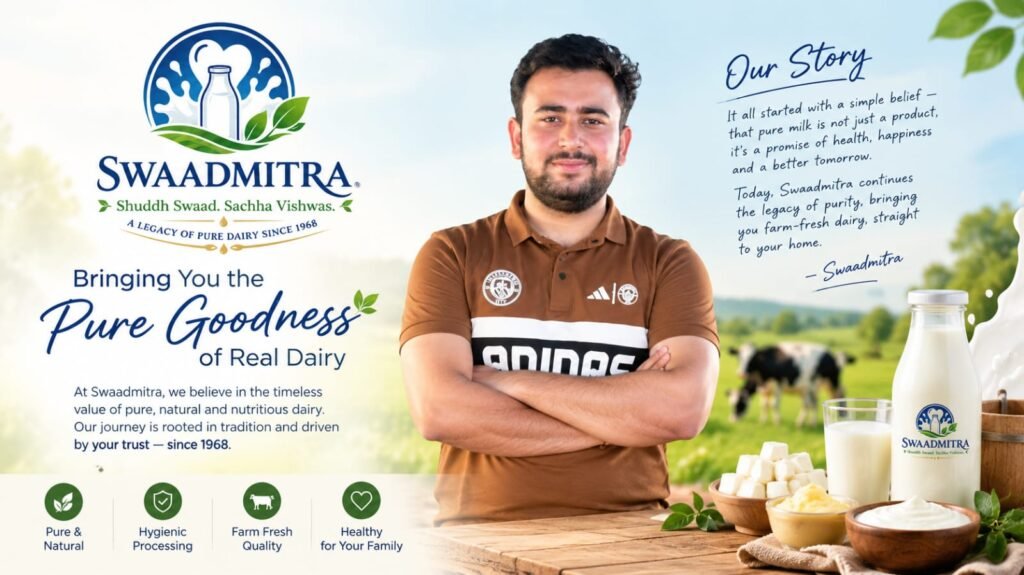
Palwal, Haryana: In a time when consumers are increasingly looking for freshness, quality and transparency in everyday food products, a young entrepreneur from Palwal is taking a traditional family dairy business into a new generation. Vansh Arora, founder of Swaadmitra, is building the brand around a simple idea—bringing the goodness of dairy to consumers while preserving the trust associated with a family legacy.

The startup has recently crossed an important early milestone, selling more than 1,000 boxes in a single month, reflecting growing consumer interest and the potential of a young brand operating in the competitive dairy segment.

What makes Swaadmitra particularly interesting is the story behind its founder. Vansh Arora is not entering the dairy business as an outsider looking for a new market. Instead, he is working to modernize and expand his family’s legacy dairy business, combining traditional experience with contemporary branding, packaging and customer-focused thinking.

From Family Legacy to Startup Vision

Swaadmitra’s story is closely connected with the family’s long association with dairy. The brand presents itself as carrying forward a dairy legacy dating back to 1968, with a focus on purity, natural products and consumer trust.

For Vansh, the objective is not simply to sell dairy products. It is about taking an established family business and building it into a recognizable modern brand.

This transition represents a familiar challenge for India’s family-run businesses. While generations may have built businesses through relationships and reputation, the next generation increasingly has access to digital marketing, e-commerce, modern packaging, social media and data-driven business decisions.

Vansh’s journey reflects that transition.

A Young Founder Balancing Education and Entrepreneurship

Vansh Arora completed his BBA from I.T.S Mohan Nagar, Ghaziabad, as part of the 2022–2025 batch. During his academic journey, he was exposed to business fundamentals, marketing, management and entrepreneurship.

Rather than waiting until the completion of his education to enter the business world, Vansh began focusing on the growth of his family enterprise.

He is currently pursuing an MBA from Amity University, while simultaneously working on expanding Swaadmitra.

Managing higher education alongside an operating business can be demanding. However, for Vansh, the combination offers an opportunity to apply classroom knowledge directly to a real business environment.

Marketing concepts, customer behaviour, branding, operations and business strategy are no longer simply academic subjects. They become practical challenges that need to be addressed while building Swaadmitra.

1,000+ Boxes in One Month

One of the biggest early milestones for Swaadmitra is its reported sale of more than 1,000 boxes in one month.

For an emerging consumer brand, this is more than just a sales number. It indicates that the company is beginning to establish demand and attract customers beyond the traditional family-business model.

The milestone also demonstrates the importance of presentation and brand positioning in today’s food market.

Consumers no longer evaluate dairy products only on price. Packaging, hygiene, freshness, brand identity, convenience and trust increasingly influence purchasing decisions.

Swaadmitra is positioning itself around these expectations.

Its communication focuses on pure and natural dairy, hygienic processing, farm-fresh quality and healthy choices for families.

Bringing Traditional Dairy Into a Modern Brand

India’s dairy market has traditionally been dominated by local milk suppliers, cooperatives and established national brands. This makes differentiation particularly important for new and emerging businesses.

Swaadmitra’s approach is to combine the familiarity of a family dairy business with the appearance and communication style of a contemporary consumer brand.

The visual identity of the brand reflects this strategy. Its branding combines dairy imagery, green elements and a strong emphasis on purity and freshness.

The message is simple: consumers should feel that they are purchasing a product connected to a real dairy legacy while receiving the convenience and presentation expected from a modern brand.

Why the Story Matters

The Swaadmitra story also highlights a larger trend taking place across India’s small and family-owned businesses.

Young entrepreneurs are increasingly stepping into businesses created by their parents and grandparents, but they are approaching them differently.

Instead of completely replacing traditional business models, many are attempting to upgrade them.

That can include:

  • Modern packaging
  • Digital marketing
  • Social media branding
  • Online customer acquisition
  • Better product presentation
  • Customer feedback systems
  • E-commerce and direct ordering
  • Data-driven decision-making
  • New distribution channels

For a legacy business, this transformation can open doors to customers who may never have discovered the business through traditional word-of-mouth alone.

Vansh Arora’s Entrepreneurial Approach

Vansh’s journey represents a combination of education, family experience and entrepreneurship.

His BBA background provided an introduction to business and management, while his current MBA journey is giving him an opportunity to deepen that knowledge. At the same time, Swaadmitra provides a practical platform where those ideas can be tested in the real market.

The 1,000-plus monthly box milestone gives the startup an early indication that the market is responding.

However, the next challenge will be much bigger: converting early traction into consistent growth.

For Swaadmitra, this could mean expanding its product portfolio, improving distribution, strengthening customer retention and building recognition beyond its home market.

The Road Ahead for Swaadmitra

The Indian dairy market offers significant opportunities, but it is also highly competitive. Established companies already have extensive distribution networks and strong consumer awareness.

For a growing brand like Swaadmitra, the advantage could come from creating a stronger connection with customers.

A clear brand story can help.

The company’s identity is not only about dairy products; it is also about a family legacy being carried forward by a new generation.

That story gives Vansh and Swaadmitra an opportunity to communicate something larger than a product.

The focus can gradually shift from simply selling dairy boxes to creating a trusted dairy brand associated with freshness, quality and family values.

A New Chapter for a Legacy Business

Vansh Arora’s entrepreneurial journey is an example of how India’s traditional businesses are evolving.

A family business that has been associated with dairy for decades is now being viewed through the eyes of a young entrepreneur who understands both traditional business relationships and modern management.

With 1,000+ boxes sold in a month, Swaadmitra has achieved an encouraging early milestone.

The bigger story, however, is what comes next.

If Vansh can successfully combine the trust of a legacy business with the branding, technology and customer experience of a modern startup, Swaadmitra could potentially grow from a regional family enterprise into a recognizable dairy brand.

For a young entrepreneur pursuing an MBA while building his family’s next chapter, Swaadmitra represents more than a startup. It represents an attempt to turn generational experience into a new-age consumer brand.

And with its early sales momentum, the next chapter of the Swaadmitra story is already beginning.

Scroll to Top