19 Dead in Kolkata Durga Puja Stampede: Who Is Accountable for the Safety Failures?
The deadly crowd crush has triggered demands for a transparent investigation into crowd management, security arrangements and the responsibilities of event organisers and authorities.
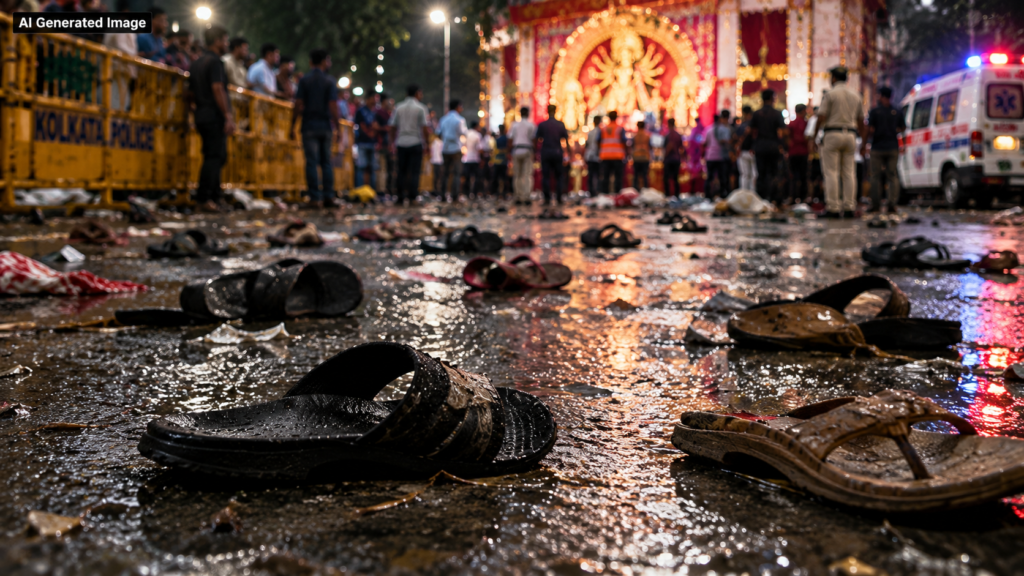
KOLKATA, October 18, 2026: A night of religious celebration turned into a tragedy at the Chorebagan Sarbojanin Durga Puja pandal in north Kolkata on Saturday, October 17, after a stampede claimed at least 19 lives and left dozens injured, according to reports published on Sunday. The incident has raised urgent questions about crowd management, emergency preparedness and accountability for safety arrangements at one of the city’s major festive gatherings.
Crowd Management Under the Scanner
Preliminary reports point to heavy crowding, rainfall and confusion around the pandal’s exit area as possible contributing factors. Reports also indicate that an announcement and whistles from private security personnel may have triggered panic. Investigators will need to establish the precise sequence of events and determine whether failures in crowd-control planning contributed to the deaths. <Cite refs={[“turn926020news22″,”turn926020search5”]}/>
The tragedy has put the spotlight on basic safety questions. Were entry and exit routes adequate for the number of visitors? Were emergency exits accessible? Was there sufficient coordination between organisers, private security personnel, police and emergency services? These questions require documented answers, not political speculation.
Political Accountability Becomes a Major Question
The incident has also intensified scrutiny of the political and administrative leadership responsible for public safety in West Bengal. Political accountability is a legitimate subject of debate whenever a major public gathering ends in mass casualties.
However, the stampede occurred on October 17, 2026, and the evidence reported so far does not establish that Trinamool Congress (TMC) workers deliberately planned the tragedy or caused it in retaliation for an election defeat. Such a claim would require evidence of planning, communications, instructions or other documented involvement.
A credible investigation should examine the responsibilities of the event organisers, security contractors, relevant municipal authorities and police officials without presuming guilt on political grounds.
Government Orders Inquiry as Organisers Face Questions
West Bengal Chief Minister Suvendu Adhikari announced a fact-finding inquiry and directed police to question members of the puja committee and those responsible for security arrangements. The probe is expected to examine the circumstances surrounding the crowd surge and the adequacy of safety measures. <Cite refs={[“turn926020search0″,”turn926020search3”]}/>
The reported detention of organisers and security personnel for questioning does not itself establish criminal guilt. Investigators must determine whether any safety regulations were violated, whether warnings were ignored and whether negligence or other offences contributed to the incident.
Questions Authorities Must Answer
The public deserves a transparent account of what happened at Chorebagan. Investigators should preserve and examine CCTV footage, review event permissions and crowd-management plans, interview eyewitnesses, and reconstruct the sequence of announcements and crowd movements.
The inquiry should also establish whether emergency medical assistance was deployed promptly and whether the venue’s layout and capacity were appropriate for the expected attendance.
If the investigation finds negligence or deliberate wrongdoing, those responsible should face appropriate legal consequences, regardless of their political connections. If claims of deliberate sabotage emerge, those claims must be tested against verifiable evidence.
Conclusion: Accountability Must Come Before Political Blame
The Chorebagan stampede has left families grieving and raised serious questions about the safety of large religious gatherings. Authorities must explain how the crowd surge occurred, whether preventive measures were adequate and what steps will prevent a recurrence.
Political leaders and parties may face legitimate questions about public safety and administrative oversight. But alleging that TMC planned the tragedy because it lost elections would go beyond the evidence currently reported.
The priority must be justice for the victims, a transparent investigation and accountability based on facts rather than unverified accusations.